
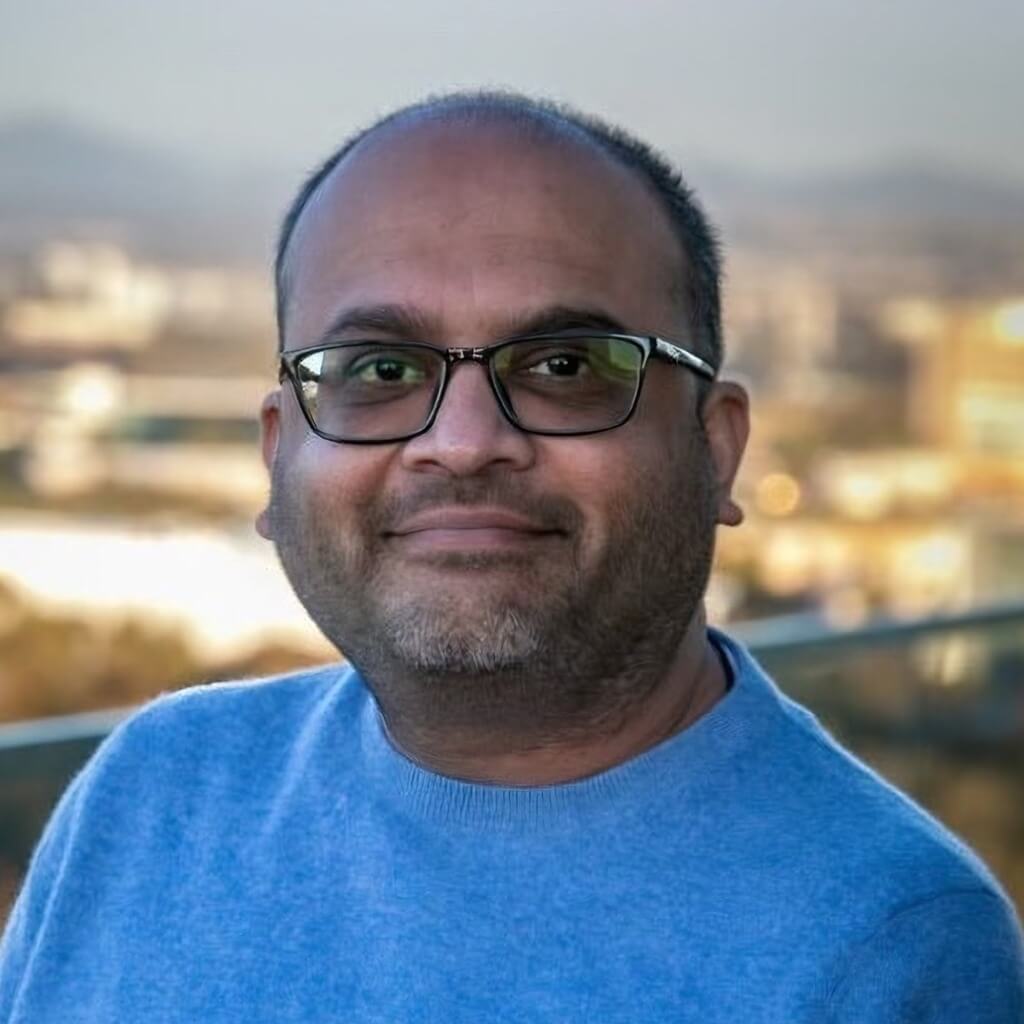
Hemal Patel is a Professor in the Department of Anesthesiology at UC San Diego, a VA Research Career Scientist, and a Co-Investigator on the UCSD REACH Center. His research focuses on mitochondrial biology and translational science, with work spanning cardiovascular disease, aging, neurodegeneration, and meditation research related to whole-person health.
In His Own Words
What project or idea are you currently most excited about?
The project that most excites me right now is our multi-omic profiling of the relationship between mind and body. We are beginning to see a unique molecular and physiological signature of energetics as a core integrating feature. Having studied the relationship between plasma membranes and mitochondria in stress adaptation for many years as a basic science problem, it is fascinating to see how many common features connect a single cell to an animal to the whole human.
What originally drew you to work in integrative or whole-person health?
I grew up deeply contemplative — comfortable sitting in silence for hours. I was raised Hindu, though I never really practiced formally, but always felt a sense that something larger than myself existed in the universe. I met my wife in high school; she was raised Catholic and faith was central to her life. In college, I explored philosophy and religion alongside biology and classical studies, because faith was something I couldn’t piece together the way I could science. My theology was shaped by two Germans: one a Hindu who became my guru, the other a pastor and professor who introduced me to Western faith. These were defining moments that ultimately led to my conversion to Christianity as an adult. As a scientist living within a worldview shaped by both reason and faith, whole-person health is a cornerstone of that way of seeing the world. We are our bodies — but our minds and thoughts matter just as much.
What is one piece of advice you received that has stuck with you throughout your career?
Find a mentor who is interested in developing you as a colleague. These individuals will become your lifelong guides and champions.
Looking back, what is something you wish you had known earlier in your career?
Know your worth as an individual — and challenge those who do not see it or will not let you express it.
What book, podcast, or resource has influenced how you think about health or research?
I recently read Transformer by Nick Lane. It aligns closely with what we are thinking about in whole-person health: that energy is what connects us both internally and externally. At the core of this is metabolism — and DNA is, in some ways, a less central player than we’ve long assumed.
What is one small habit that improves your daily well-being?
Think before I speak and interact — and try to see the good inside the person on the other end. When I don’t do this, the day is invariably less productive. When I do, life seems remarkable.